Vast deposits of oil and natural gas are tightly trapped between layers of shale rockShale RockA fine-grained sedimentary rock formed from compacted mud and clay. Its low permeability traps oil and gas within tiny pores and fractures. formations across the central United States.The largest shale formations in the U.S. include the Marcellus Shale (Appalachian Basin), the Permian Basin in Texas, and the Bakken Formation in North Dakota — together holding billions of barrels of recoverable oil and gas. Until a few decades ago, these deposits remained untapped. Extracting the oil or natural gas from where it was tightly held between rock layers was too difficult and costly.
This situation changed in the late 1990s when oil and gas producers combined two existing extraction technologies.Neither technology was invented for fracking — horizontal drilling had been used in oil fields since the 1980s, and hydraulic fracturing dates back to experiments in the 1940s. Combining them was the breakthrough. One is horizontal drillingHorizontal DrillingA technique where a vertical well is first drilled straight down, then the shaft curves to drill sideways — reaching deposits spread horizontally underground., which involves drilling a vertical well deep into the ground, turning the flexible shaft of the drill, and then drilling horizontally. This technology provides a way to reach tightly held oil and natural gas deposits.
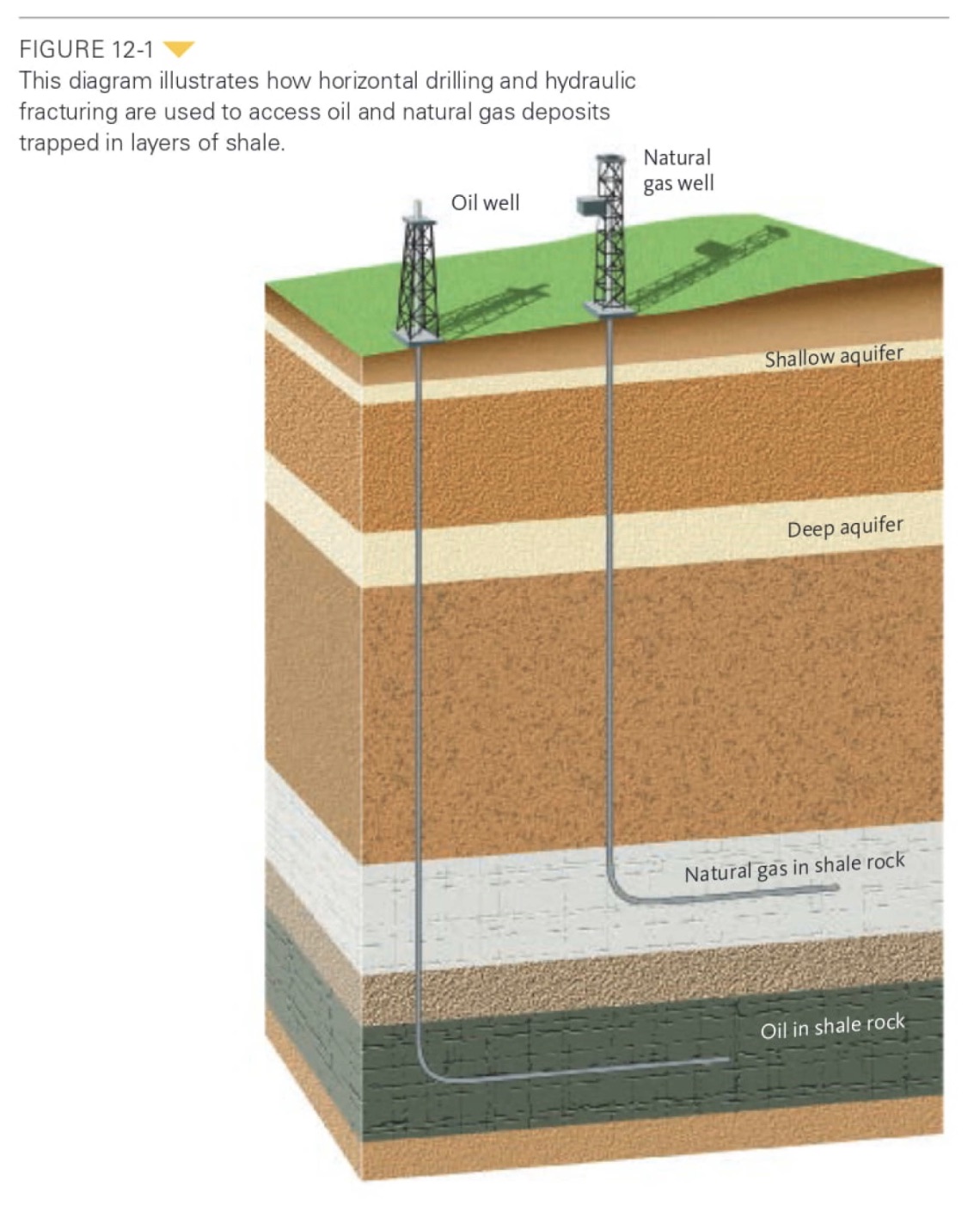
The second technology, called hydraulic fracturingHydraulic Fracturing (Fracking)A process that injects high-pressure fluid into rock to crack it open and release trapped oil or gas. "Hydraulic" refers to the use of pressurized liquid. or fracking, is used to free the trapped natural gas and oil. Fracking involves using high-pressure pumps to inject huge volumes of a mixture of water, sand, and chemicals into the horizontal well.A single fracking operation can use between 1.5 and 16 million gallons of water — enough to fill several Olympic swimming pools. This places significant strain on local water supplies, especially in arid regions. The mixture then blasts through holes drilled in the underground well pipe.
The force of the blast fractures the surrounding shale rock and drives grains of sandProppant (Sand)Sand grains "prop open" the newly cracked fractures. Without them the cracks would squeeze shut again once pressure is released. into the cracks to hold them open. When the pressure is released, the oil or natural gas flows out of the cracks. Then it is pumped to the surface.The pressure used in fracking can exceed 15,000 pounds per square inch — roughly 1,000 times the pressure in a car tire. Researchers have also linked the underground disposal of fracking wastewater to increased earthquake activity in some regions.
The mixture that is injected into the well contains naturally occurring saltsNaturally Occurring SaltsDissolved minerals leached from deep rock formations. These brines can be far saltier than seawater and toxic to surface ecosystems., toxic heavy metalsToxic Heavy MetalsElements like arsenic, barium, strontium, and lead that occur naturally in rock. At high concentrations they are harmful to humans and wildlife., and radioactive materialsRadioactive Materials (NORM)Naturally Occurring Radioactive Materials — like radium — dissolved from deep rock. Long-term exposure can increase cancer risk. leached from the rock.Fracking companies are not required by federal law to disclose all the chemicals they use — a loophole sometimes called the "Halliburton Loophole," added to the Safe Drinking Water Act in 2005. Some states have passed their own disclosure requirements. Fracking companies also add potentially harmful drilling chemicals to the mix. After fracking is complete, about half the mixture remains below ground, while the other half becomes wastewaterFracking Wastewater (Flowback)Fluid that returns to the surface after fracking — a mix of injected chemicals and dissolved rock minerals, making it highly hazardous and difficult to treat..The half that stays underground is a major unknown. Scientists are still studying how it moves through rock over time and whether it can eventually reach groundwater supplies decades later.
Processing the hazardous wastewater is a challenge. It may be stored in underground wellsUnderground Injection Wells (UIC)Deep wells used to dispose of liquid waste. EPA-regulated, but leaks and induced seismic activity remain ongoing concerns. or in surface holding pondsSurface Holding PondsOpen-air lined pits that store wastewater on site. Liner failures, wildlife contact, and overflow can contaminate nearby soil and water., where it can leak.In 2014, a holding pond spill in West Virginia released thousands of gallons of fracking wastewater into a tributary of the Elk River, contaminating the drinking water supply for 300,000 residents for several days. It may be sent to sewage treatment plantsSewage Treatment Plants (WWTP)Designed for municipal waste, not industrial chemicals or radioactive brine. Most lack equipment to safely remove fracking contaminants. that are often ill-equipped to handle it properly. Or it can be cleaned up and used again for fracking — the best method but also the most rarely used because of its high cost.Water recycling for reuse in fracking has grown in some regions — in Pennsylvania's Marcellus Shale, recycling rates climbed from near zero to over 90% between 2008 and 2016, driven more by economics than regulation.
Some say fracking marks a new era in oil and natural gas production. But the process also yields lower net energyNet Energy (EROI)Energy Return on Investment — usable energy produced minus the energy needed to extract it. Fracking's intensive pumping and equipment demands shrink this margin compared to conventional drilling. compared to traditional production.Conventional oil wells in the 1930s had an EROI of roughly 100:1 — meaning 100 units of energy returned for every 1 spent. Fracked shale wells average closer to 5:1 to 10:1, making them far less energy-efficient per barrel produced. Oil and natural gas prices must remain high to make it profitable to frack oil and natural gas.When oil prices crashed in 2015–2016, hundreds of U.S. fracking companies went bankrupt because their high extraction costs couldn't be covered by low market prices — a direct consequence of fracking's lower net energy return.